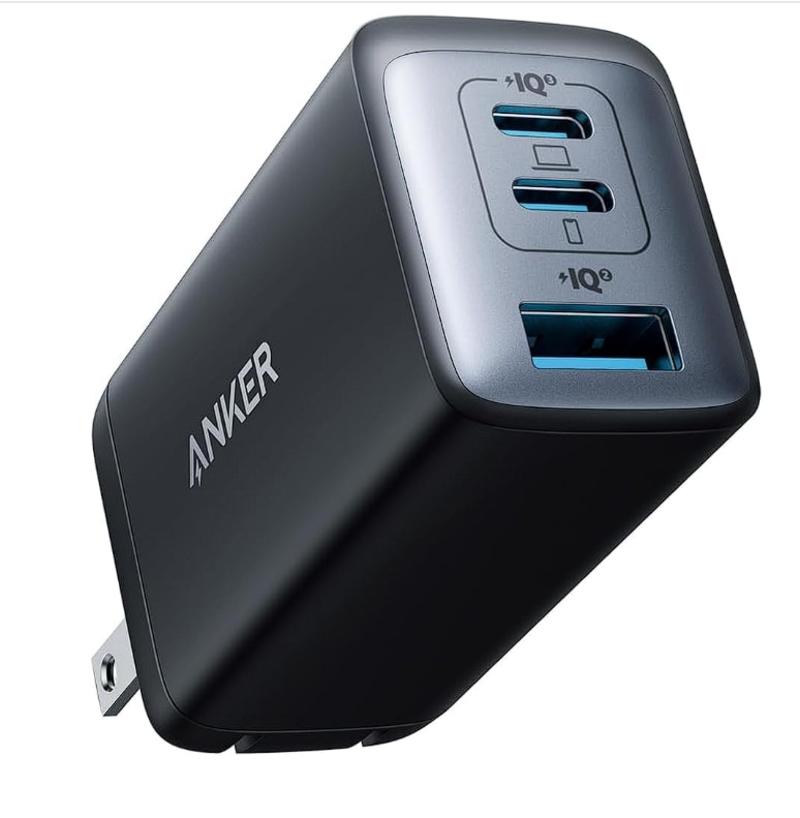
There's a drawer in my home office that I'm embarrassed by. It contains: one MacBook brick, one 30W USB-C adapter, one old iPhone 12W brick, a tangle of cables, and a surge protector that's so overloaded it looks like a fire hazard in waiting. I've known for years that I should simplify this mess. The Anker 735 — a 65W three-port GaN charger the size of a small soap bar — finally made me do something about it.
GaN Technology in Plain English
GaN stands for Gallium Nitride, a semiconductor material that's replaced the traditional silicon used in most chargers. The practical difference: GaN chargers run more efficiently, generate less heat at the same wattage, and can be made significantly smaller than silicon-based chargers of equivalent power. The Anker 735 delivers 65W from a charger roughly 40% smaller than the standard Apple 61W MacBook brick. That's the value proposition.
Ports and Power Distribution
The 735 has three ports: two USB-C and one USB-A. Here's how the power splits depending on what you plug in:
One USB-C port only: 65W (full power, great for MacBook charging)
Two USB-C ports: first port gets up to 45W, second gets up to 20W
All three ports active: approximately 45W + 20W + 10W across the three ports
USB-A alone: up to 22.5W (fast charge for phones that support it)
In daily use: I plug in my MacBook Air (USB-C1 at 45W), my phone (USB-C2 at 20W), and my earbuds case (USB-A at 5W). All three charge simultaneously and all three are topped up by the time I sit down to work. This replaced three separate adapters.
Charging Speed Real-World Tests
MacBook Air M2 from 15% to 100% while actively using it: about 1 hour 45 minutes. That's roughly 10% slower than Apple's dedicated 67W charger, which is imperceptible in practice. iPhone 14 Pro from 20% to 100% with USB-C2 at 20W: about 1 hour 10 minutes, slightly faster than Apple's 20W brick because of the efficient power delivery. AirPods Pro case from empty to full: under 45 minutes.
Size and Travel Worthiness
The prongs fold flat, making this genuinely pocket-sized. I've been keeping the 735 in my laptop bag as my travel-everything charger and I can't overstate how much mental overhead it removes. One adapter, one cable, done. The finish is matte white (black also available), and after three months it shows minimal scuffing. It doesn't overheat alarmingly — gets warm under heavy load but well within what's normal for a high-wattage charger.
Where It Falls Short
Honest Criticisms
The 65W is shared across all ports simultaneously. This is stated clearly in the specs but easy to miss: if all three ports are loaded, your MacBook gets ~45W, not 65W. Fine for maintenance charging while working, slower if you need to top up quickly.
The folding prongs feel slightly loose in some wall outlets — there's barely-perceptible wobble. It stays plugged in fine, but it's not as satisfying as the solid lock of an Apple brick.
No cables included. At $35-45, this stings. At least one USB-C cable would make this a complete package rather than a charger you have to accessorize.
The USB-A port maxes at 22.5W with Quick Charge support. Fine for phones, but if you have a USB-A device that needs more, this isn't it.
The GaN charger market has gotten crowded. Competitors like Ugreen, VOLTME, and Baseus now offer equivalent specs at $25-30. Anker still has better brand trust for quality control, but the price premium has narrowed.
Who Should Buy This?
Buy it if: you travel with a MacBook and hate carrying multiple chargers, you charge a laptop, phone, and earbuds simultaneously, or you want a compact single charger for your desk that handles everything.
Skip it if: you need to fast-charge a laptop AND a phone simultaneously at maximum speed (the power split limits this), you want the absolute cheapest GaN option (check Ugreen), or you prefer to carry dedicated single-device chargers for each device.
The Anker 735 is a well-engineered product that solves a real problem elegantly. I give it an 8 out of 10. The missing cable and power-splitting caveats are worth understanding before you buy, but for the use case of 'one charger for everything' it's the best option I've used at this form factor.